Anxiety or Intuition?
Something I have been processing lately is the difference between listening to my anxiety and trusting my gut instinct. Often in counseling, helping a client learn to trust and connect to their body is the first task on our work together. We work together to learn how to connect to their body to ultimately trust themselves. Through trauma, our family of origins, and our relationships, we can often lose sight of who we are and what our bodies are telling us.
You might have heard of the book The Body Keeps the Score by Van der Kolk (2014). I highly recommend this book if you are desiring to learn more about yourself, have compassion for others, and learn how our life experiences impact us today. One point from this book I would like to highlight is that trauma impacts how we feel about ourselves and our bodies. Listening to our gut instincts gives us information. But…
What happens if our instinct is wrong? What happens if we can’t trust ourselves?
Learning to trust yourself and your instinct takes time. Van Der Kolk writes about the powerful act of mindfulness and yoga to connect oneself to your body. When we have experienced trauma, our connection between our bodies and our minds are severed. They stop listening to each other. These tools help restore the connection between our minds and our bodies (2014).
I have a client I have been working with that is processing these big questions. They have mentioned that through disordered eating and some OCD tendencies, it can be difficult to know what their fear and anxiety is communicating versus what their instinct and gut is telling them. Maybe you have been asking yourself this too.
So… How do we differentiate the two?
Intuition is automatic, unconscious, and without bias. Our past experiences are collected, and our brains form a response to the incoming information, making a decision in split seconds (Sinclair, 2011). You may notice this shows up as a gut feeling.
Anxiety on the other hand is a feeling that comes from anticipatory fear. Anxiety is an emotional response involving anticipation of potential danger or unwanted outcomes, typically associated with heightened physiological arousal and worry.
Here is a breakdown of the differences between how anxiety and intuition differ:
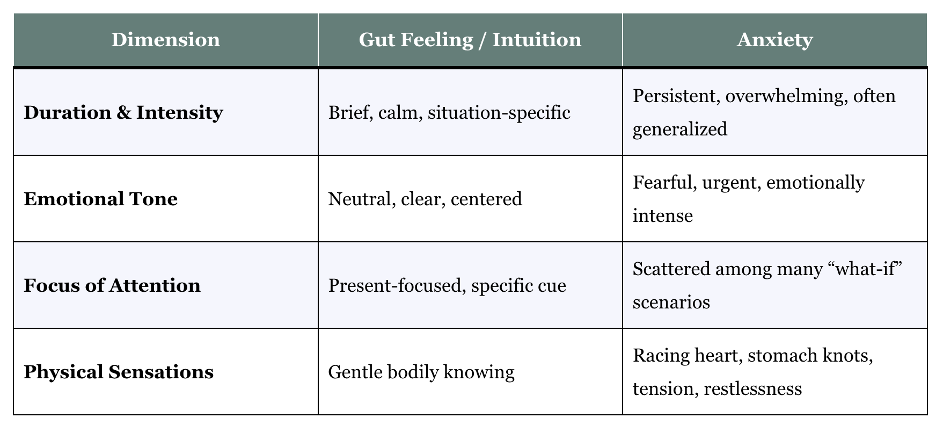
(Guy-Evans, 2025)
As you grow more in tune with your body, you will begin to differentiate the differences between your intuitions and your anxiety. Ultimately, this will allow you to make your decisions more effectively with honesty towards your true self.
If you would like help talking through a difficult decision, learning how to connect to your body or needing someone without bias to hear your experiences, do not hesitate to reach out.
Hope you have a great week!
References:
Guy-Evans, O. (2025, August 29). Gut feeling vs. anxiety: How to tell the difference. Simply Psychology. https://www.simplypsychology.org/gut-feeling-or-anxiety.html
Sinclair, M. (Ed.). (2011). Handbook of intuition research. Edward Elgar Publishing.
Van der Kolk, Bessel A.. (2014). The body keeps the score : brain, mind, and body in the healing of trauma. . New York: Penguin Books Ltd..